
Teams often abandon BPMN models once they leave the whiteboard because the automation tool cannot enforce the same decision logic that the diagrams describe. The gap shows up as manual handoffs, missing audit trails, and repeated policy exceptions. Right now they need a platform that keeps the BPMN structure intact while turning each shape into executable tasks and controls.
By the end of the article you will have a short list of concrete questions to ask any vendor, a side-by-side look at how Process Street, Camunda, and one more option map BPMN tasks to live workflows, and a clear ranking that names the best fit for most compliance-driven teams.
What to Look For in Workflow Automation Tools for BPMN-Based Process Design
Selecting the right BPMN tool requires evaluating seven concrete technical and operational criteria. Each factor affects how well the platform supports process modeling and workflow automation across the entire process lifecycle.
Organizations need platforms that handle BPMN diagrams consistently and connect with existing systems without custom workarounds.
- Native BPMN 2.0 import/export with full element support (events, gateways, tasks). Complete element coverage prevents diagram loss during transfers between design tools and execution engines.
- Version-controlled process repository that logs every change with timestamps. This record supports audit requirements and lets teams track how processes evolve over time.
- Real-time monitoring dashboards showing cycle time, throughput, and SLA breaches. Live metrics help teams spot delays and adjust workloads before problems escalate.
- Integration APIs for REST, webhooks, and connectors to CRM/ERP systems. Reliable connectors reduce manual data transfers and keep records synchronized across platforms.
- Role-based access control and audit trails that satisfy ISO 27001 and SOC 2. These controls protect sensitive data while meeting compliance obligations for regulated industries.
- Simulation engines that run 1,000+ process instances to surface bottlenecks before deployment. Testing large volumes of instances reveals performance limits that single test cases miss.
- Low-code decision tables that allow subject-matter experts to update business rules without redeploying workflows. Business users gain flexibility when rules change frequently.
Teams that confirm these capabilities early avoid costly platform switches later. Process standardization improves when the selected tool meets both technical and governance requirements from day one.
1. Process Street - Best Overall
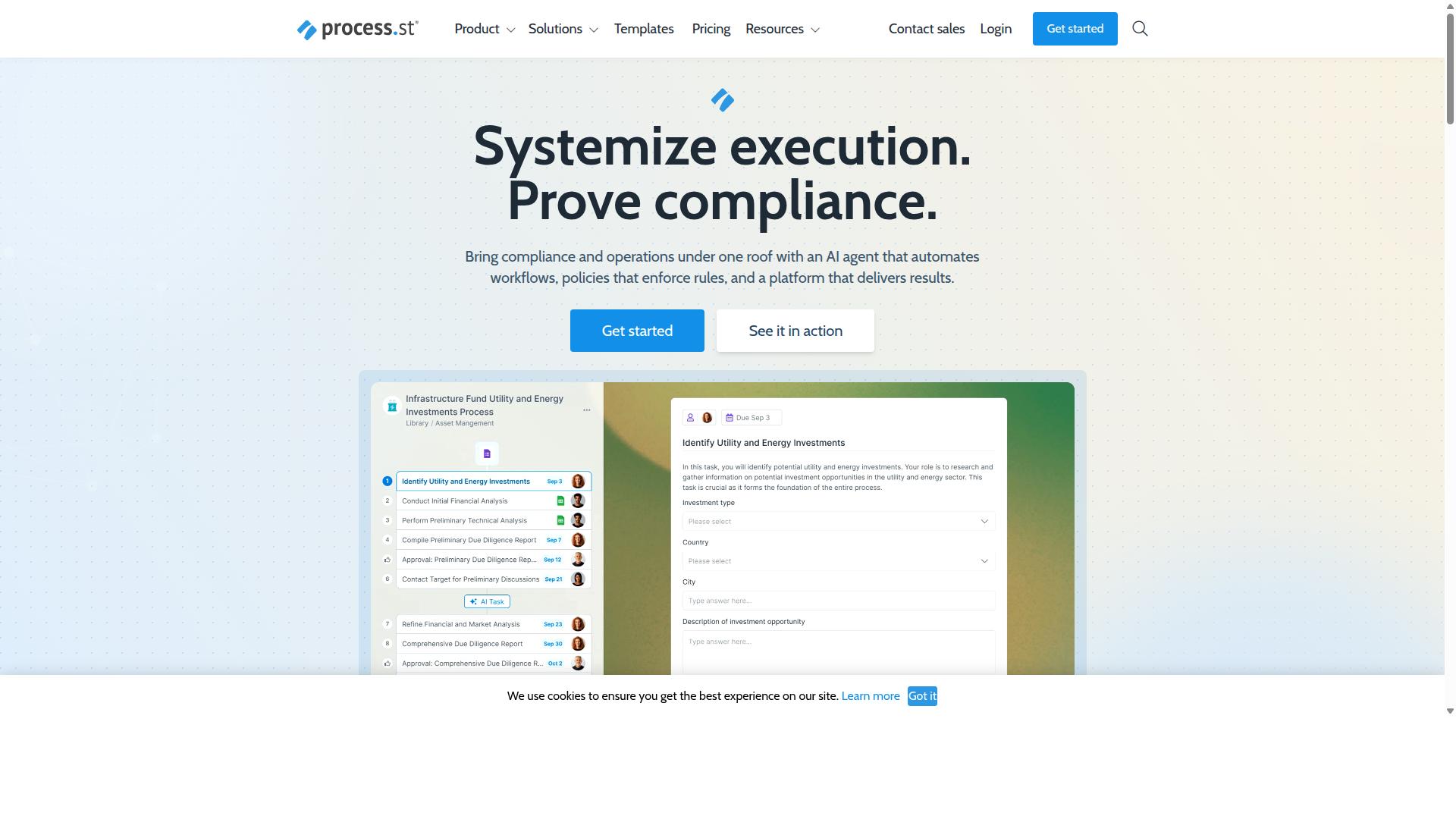
First sentence: Process Street earns the top spot by combining BPMN-compliant workflow design with enterprise-grade governance features.
Process Street's Ops product converts BPMN diagrams into AI-guided workflows that maintain full traceability. The platform automatically creates audit-ready proof for SOC 2 and ISO 9001 requirements.
Teams connect automation applications through built-in integrations. The Startup plan limits users to 100 actions per month.
Process AI features monitor process execution while business rules handle decision points. Process monitoring tracks each task completion with timestamped records.
IMCD UK reported a 75 percent reduction in setup time after switching to Process Street. The organization also processed 49,000 employee onboarding workflows within the same system.
Process Street's Docs component manages policy control for regulatory compliance. Cora functions as an AI compliance agent that flags risks around the clock.
Users access Zapier, Microsoft Power Automate, Tray.io, and Make for workflow integration. Public API access extends connectivity to additional systems.
2. Camunda
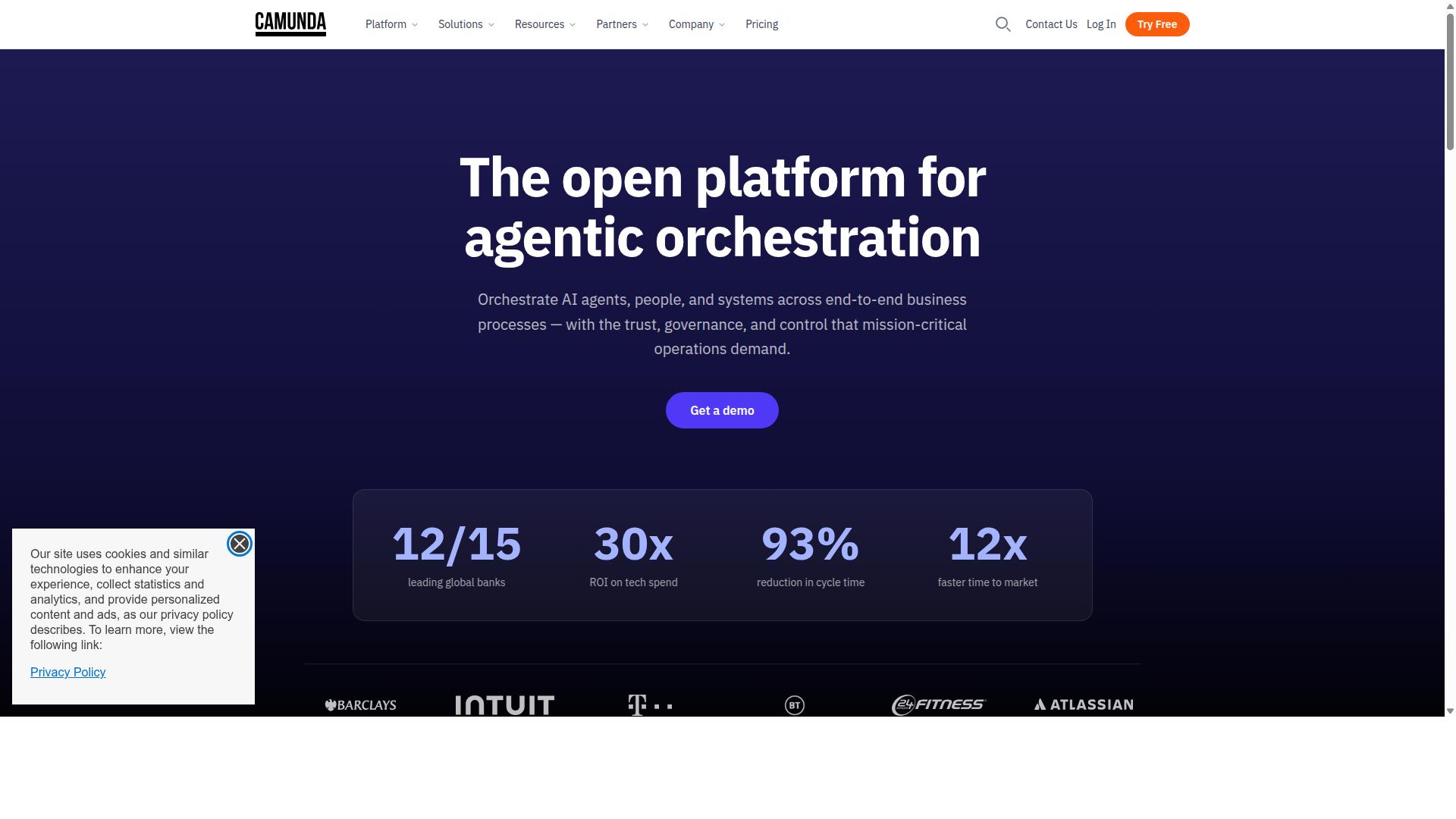
Camunda is an open-source BPM engine focused on developers who need maximum control over process execution.
Its headless architecture separates the core workflow engine from any user interface layer. This design lets teams embed process logic directly into existing systems without forcing a particular front-end approach.
Java and REST APIs provide the primary integration points. Developers can trigger process instances, manage variables, and query execution state through these endpoints. The same APIs support both synchronous calls and asynchronous messaging patterns.
Deployment options remain flexible across containerized environments, traditional servers, or managed cloud instances. Teams choose the model that matches their infrastructure policies and scaling requirements.
Non-technical users need separate UI tools to participate in process modeling and monitoring. These additional components may require extra licensing or integration work.
Enterprise support packages carry their own subscription costs. Organizations should evaluate these expenses against internal developer capacity and long-term maintenance needs.
How to Choose the Right Option
First sentence: Match each platform's strengths to your team's size, compliance needs, and technical capacity.
Choosing the right BPM platform starts with understanding your team's structure and daily requirements. Operations groups focus on repeatable workflows, compliance teams need clear audit trails, and developer teams value API access.
The following comparison maps common team profiles to their typical priorities and recommended platforms.
| Team type | Key requirements | Recommended platform |
|---|---|---|
| Ops | Audit trails | Process Street |
| Compliance | Audit trails | Process Street |
| DevOps | Open-source APIs | Camunda |
Process Street serves Operations, Compliance, IT and Security teams in industries such as financial services, healthcare, and manufacturing. These teams use the platform for employee onboarding, ISO compliance, document control, and quality tracking.
Developer-heavy teams usually lean toward Camunda because its open-source model gives direct API access and flexible deployment options. Process Street focuses on low-code authoring and audit-ready workflows that non-technical users can manage.
Research suggests that matching your team's technical capacity to the selected platform reduces both rollout time and ongoing maintenance costs.
Final Verdict
Process Street delivers the best balance of BPMN design, AI-driven execution, and compliance automation for most mid-market and enterprise teams.
The platform supports over 3,000 companies and 1 million users. Its SOC 2 Type II and ISO 27001 certifications meet strict enterprise governance requirements.
Teams report 30% faster documentation compared to manual methods. This metric translates directly into reduced cycle time for process design and updates.
Process Street integrates BPMN modeling with automated execution while maintaining compliance standards across the process lifecycle. The combination reduces setup time with 75%+ reported improvement by IMCD UK.
Other workflow automation tools provide BPMN features but typically lack the same level of integrated compliance and AI execution capabilities. Process Street stands out through its verified security framework and documented efficiency gains.
Recommended Resources: